
budoshop.com
budoshop.com: Independent Guides to Martial Arts Equipment
budoshop.com is an independent editorial site explaining martial arts uniforms, belts, protective gear and training weapons, with a buying guide and glossary.
24 articles · 54 glossary terms
Explore
Topics
 Martial Arts and Their Equipment: A Complete Overview
An overview of the martial arts covered on budoshop.com and the uniforms, protective gear and training weapons each one typically uses.
02
 Martial Arts Equipment Buying Guide
A practical, step by step guide to buying the right martial arts equipment for your art and level, from your first uniform to protective gear and wea…
03
 Uniforms and Belts Explained
A guide to how gi, dobok and hakama are constructed, what federations allow, and how belt colours and grading systems work across schools.
04
 Protective Gear for Martial Arts
What protective gear each martial art typically uses, how to size it correctly, and how to keep it hygienic between sessions.
05
 Training at Home: Setting Up a Home Dojo
How to set up a safe, effective space to train martial arts at home, from mats and a heavy bag to solo drills and keeping a consistent routine.
Martial Arts Glossary: Terms Explained from A to Z
From A to Z: 54 terms explained

Welcome to budoshop.com, an independent editorial guide to martial arts equipment for anyone who trains, or who is only starting to think about it. Budo is the Japanese word for the martial way, and we use it here as a broad umbrella for the many arts and equipment traditions this site covers, from Japanese and Korean striking and grappling arts through Brazilian jiu jitsu, boxing, kickboxing and Muay Thai, mixed martial arts, Krav Maga, Wing Chun and capoeira.
We are a small team of martial arts instructors and equipment specialists, not a shop and not a testing laboratory. We do not publish rankings, star ratings or head to head product tests, and we never claim that one brand or one specific model is the right choice for every student. Instead, we explain how uniforms, belts, protective gear and training weapons are built, sized and cared for, so that you can walk into a dojo, a club, a seminar or an online listing and understand exactly what you are looking at, whichever style you practise.
What you find on budoshop.com
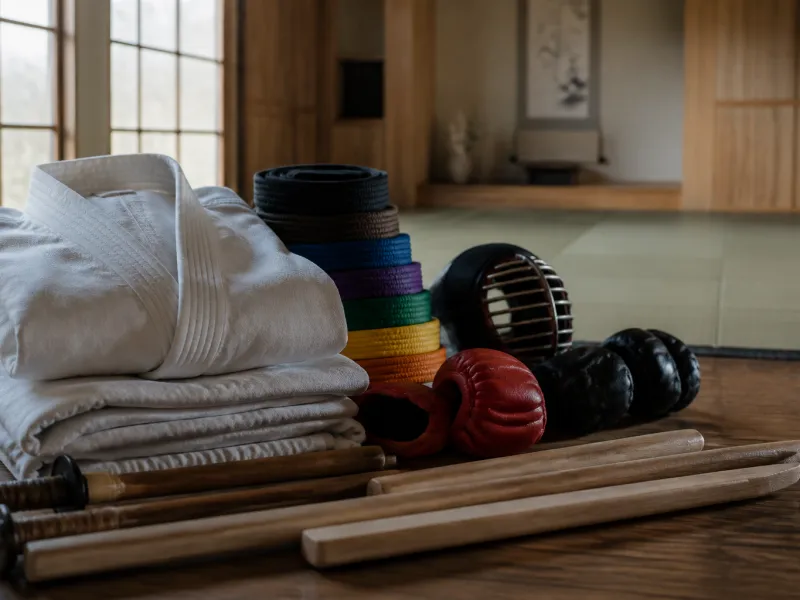
The site is organised around a small number of overview pages and a larger set of focused guides. Start with our overview of martial arts and their equipment if you are not yet sure which style interests you, or move straight to our buying guide if you already know roughly what you need. For a closer look at a specific category, our uniforms and belts overview covers the various gi, dobok and hakama traditions and how grading systems work, while our protective gear overview explains gloves, shin guards, mouthguards and head guards across the striking and combat sports.
If you train, or plan to train, outside a club as well, our training at home overview looks at mats, bags and the basics of setting up a safe practice space in a spare room or garage. Our shop groups equipment by category with links to current listings, and our glossary explains the vocabulary you will meet along the way, from Japanese honorifics to fabric weights. Everything on the site that goes into more depth than an overview page lives under our full list of guides, which grows as we add new topics.
Guides for every step of your training
Once you know roughly what you are looking for, our guides go into detail that the overview pages only summarise. If you already train in a striking art, our karate gi guide and taekwondo dobok guide explain the cut, weight and closure differences between styles and federations, while grapplers will find our judogi guide and BJJ gi guide more relevant, since the two uniform traditions look similar but are built to different standards and rules. Sizing gets its own dedicated page too, since gi fabric behaves differently once washed: see our guide to gi sizing and shrinkage before you order your first uniform.
For weapons based arts we have a kendo equipment guide covering the shinai and bogu armour, an aikido and hakama guide, and a broader weapons training guide covering the bo, jo and bokken across several arts. Boxers, kickboxers and mixed martial arts practitioners will find our boxing glove sizing guide useful, and every belt system, from coloured kyu grades to black belt dan grades, is explained in our belt guide and tying instructions. Parents and adult beginners of any age can start with our first gear for beginners and children's equipment guide, and once you own equipment, our gi care and washing guide and home dojo setup guide help you look after it and practise safely between classes.
How to choose your first equipment, in brief
If you are only starting out, resist the urge to buy everything at once. Most clubs and dojos will tell you exactly what you need for your first weeks, and many beginner courses lend or include a basic uniform for the first term while you decide whether the art suits you. As a general rule, your first purchase should be the uniform your school actually requires, since a karate gi, a judogi, a BJJ gi and a taekwondo dobok are cut and woven differently and are not interchangeable even though they look alike from a distance.
Fit matters more than any other single factor at the beginner stage. A uniform that is too large will slow you down and can be unsafe during throws or close grappling, while one that is too small restricts movement and wears out faster at the seams. Buy your uniform sized to your current height and weight rather than for room to grow into, and expect natural cotton weaves to shrink somewhat over the first few washes, which our sizing guide explains in more detail. Protective gear such as mouthguards, shin guards and gloves should always be bought new for a proper, hygienic fit rather than secondhand, and your instructor can tell you exactly which pieces your style and grade require before your first sparring or randori session.
Beyond the uniform itself, a simple kit bag, a water bottle and, for grappling and weapons arts, a small towel for the tatami cover most beginners' needs for the first months. There is rarely any benefit to buying advanced or competition specific gear before you have a clear sense of how often you will train and how your chosen art actually feels in practice.
How to use the glossary
Martial arts vocabulary mixes Japanese, Korean, Portuguese and English terms, and even experienced practitioners sometimes meet a word from a style other than their own. Our glossary lists these terms from A to Z, from everyday words such as dojo and sensei to equipment specific terms such as gi weight, pearl weave or IJF approved, each with a short, plain explanation and a link back to the guide where the term matters most. If you come across an unfamiliar word anywhere on this site, in class, or on a product listing elsewhere, the glossary is the fastest way to look it up.
It also works well as a starting point if you simply want to browse and understand how the pieces of different traditions fit together, from the belt on a judoka's waist to the armour a kendoka wears under a shinai strike. Whatever brought you here, whether you are choosing your very first uniform, comparing belt systems across styles, or simply curious how a shinai differs from a bokken, budoshop.com aims to give you the background to make sense of it, without steering you toward a specific brand or product. When you are ready to look at product categories, our shop is organised the same way our guides are.
Guides
From the guides
 Aikido hakama guide: when it is worn, fabrics, sizing and foldingA practical guide to the aikido hakama: fabrics, sizing by height, tying, folding and care.
 Beginners' first gear: what you actually need to startWhat to buy first for karate, judo, BJJ, taekwondo, boxing and kendo, what can wait, and how to borrow gear as a beginner.
 Belt Guide: Widths, Materials and TyingHow to choose, tie and care for a martial arts belt, with a step by step tying method and notes on colour systems.
 BJJ Gi Guide: Fabric, IBJJF Rules and SizingHow to choose a BJJ gi: fabric weaves, ripstop trousers, IBJJF rules on colour and fit, and A0 to A5 sizing.